

Les microalgues, sentinelles de l’état écologique des plans d’eau : les étapes clés de l’élaboration et du transfert d’un indicateur biologique
Les microalgues — organismes unicellulaires vivant en suspension ou fixés sur des substrats — jouent un rôle clé dans l’évaluation de l’état écologique des plans d’eau. Ces organismes, sensibles aux perturbations environnementales, constituent des bioindicateurs privilégiés. Pour répondre aux exigences de la directive cadre européenne sur l’eau (DCE), la France a développé deux indicateurs complémentaires basés sur ces organismes : l’indice phytoplancton lacustre (IPLAC) et l’indice biologique diatomées en plans d’eau (IBDL). Cet article retrace les principales étapes de leur conception et de leur mise en œuvre, mettant en lumière l’apport essentiel de la recherche pour éclairer les politiques de gestion des milieux aquatiques.
Introduction
Les microalgues comptent parmi les principaux producteurs primaires des plans d’eau, avec les macrophytes. Ces microalgues unicellulaires vivent sous forme fixée (phytobenthos), principalement dans les zones peu profondes des plans d’eau, ou en suspension dans la colonne d’eau (phytoplancton). Elles assurent un large éventail de fonctions écologiques (émission d’oxygène et piégeage du carbone, production de matière organique, cycle des nutriments, épuration des eaux, ressource trophique contribuant au transfert d’éléments vers les consommateurs primaires…). Ces organismes cosmopolites sont extrêmement diversifiés (Guiry et Guiry, 2023) et montrent face à la pollution des degrés de résistance très différents en fonction des espèces. Leur taux de multiplication élevé, leur interaction constante avec leur environnement chimique (substances dissoutes environnantes), en font ainsi d’excellents indicateurs d’eutrophisation et de qualité générale des eaux (Wu et al., 2017).
Le phytoplancton et le phytobenthos (ici vu sous la seule fraction des diatomées benthiques) sont ainsi des éléments biologiques identifiés par la directive cadre sur l’eau (DCE) pour participer à la définition et à l’évaluation de l’état écologique des plans d’eau. Chaque pays membre est tenu de disposer d’indicateurs basés sur ces maillons biologiques, et de les mettre en œuvre selon un programme de surveillance précis.
Dans ce contexte, un premier indicateur de l’état écologique des plans d’eau basé sur le phytoplancton a été développé pour la France en 2013. Il s’agit de l’indice phytoplancton lacustre (IPLAC ; Feret et Laplace-Treyture, 2013 ; Laplace-Treyture et Feret, 2016). Cet indice multimétrique, incluant une métrique de biomasse algale (calée sur les concentrations en chlorophylle-a) et une métrique de composition spécifique (calée sur les préférences trophiques des taxons observés), permet de retranscrire l’état trophique général des plans d’eau.
Historiquement, les indices basés sur les communautés de diatomées benthiques ont été quant à eux développés pour les rivières, puis ont été appliqués tels quels aux plans d’eau par la majorité des États membres (Poikane et al., 2016). Ce fut notamment le cas pour la France avec l’indice biologique diatomées (IBD). Mais le premier exercice dédié d’intercalibration européenne révéla une faible corrélation entre les valeurs de l’IBD en plan d’eau et le phosphore total (Kelly et al., 2014) : de nombreux taxons lacustres étaient notamment absents de la liste des espèces clés utilisées pour le calcul de l’IBD, entraînant une faible pertinence de cet indice pour l’évaluation des plans d’eau.
Il était donc nécessaire de développer un indice diatomique dédié à ces masses d’eau. Une campagne exceptionnelle d’acquisition de données fut ainsi organisée à l’été 2015 (basée sur des recommandations précises d’échantillonnage, Morin et al., 2010), et poursuivie jusqu’en 2017 dans le cadre des réseaux de surveillance de l’état écologique des plans d’eau. Une version préliminaire de l’indice a alors été proposée sur la base de ces données. La représentativité spatiale et temporelle a ensuite été accrue par des prélèvements floristiques et physico-chimiques complémentaires, entre 2018 et 2020, permettant d’obtenir une assise plus conséquente du jeu de données, et d’optimiser ainsi la sensibilité et la robustesse de l’indice. Une version stabilisée de l’indice, nommée indice biologique diatomées en plans d’eau (IBDL) a ainsi été produite en 2021 (Tison-Rosebery et al., 2023).
Dans cet article, nous proposons d’illustrer via la présentation de l’IPLAC – basé sur le phytoplancton – et de l’IBDL – basé sur les diatomées du phytobenthos – les différents aspects liés au cycle de vie d’un indicateur biologique tel qu’exigé par la DCE, et dédié au contexte français. De son développement à son transfert aux opérateurs de terrain et acteurs de la politique publique de gestion des milieux aquatiques, le scientifique mobilise toute son expertise aux différentes étapes de ce processus afin de fournir un outil fiable et efficace. Il en assure également la mise à jour régulière afin de suivre l’évolution de la taxonomie et maintenir ainsi la pertinence des évaluations produites.
Construction d’un nouvel indice
Cette phase initiale de la vie d’un indicateur est ici illustrée par l’IBDL.
L’acquisition de données : une étape cruciale
Au niveau européen, selon les pays, l’échantillonnage des diatomées préalable au calcul d’un indice en milieu lacustre peut être réalisé sur substrat minéral dur ou sur substrat végétal. Nous avions donc proposé un protocole d’échantillonnage (Morin et al., 2010) préconisant le prélèvement sur les deux types de substrats lors des campagnes dédiées à la mise en place de l’indice, ceci afin de pouvoir a posteriori évaluer la possibilité d’échantillonner exclusivement sur l’un des types de substrats.
Les diatomées ont ainsi été collectées durant la période estivale, chaque année de 2015 à 2020, au niveau d’unités d’observation (UO) dans 93 plans d’eau. Les UO sont définies par le protocole français d’échantillonnage des macrophytes en milieu lacustre NF T90-328 (AFNOR, 2022), le choix de prélever les diatomées à cette échelle permettant de combiner ultérieurement les évaluations fournies par ces deux maillons biologiques, tel que préconisé par la DCE.
Des données biotiques et abiotiques complètes ont été obtenues pour 1 021 échantillons (figure 1). Des données floristiques correspondant aux deux types de substrat échantillonnés étaient disponibles pour 732 UO. Au total 1 091 taxons ont été dénombrés, dont 10 % au niveau du genre.
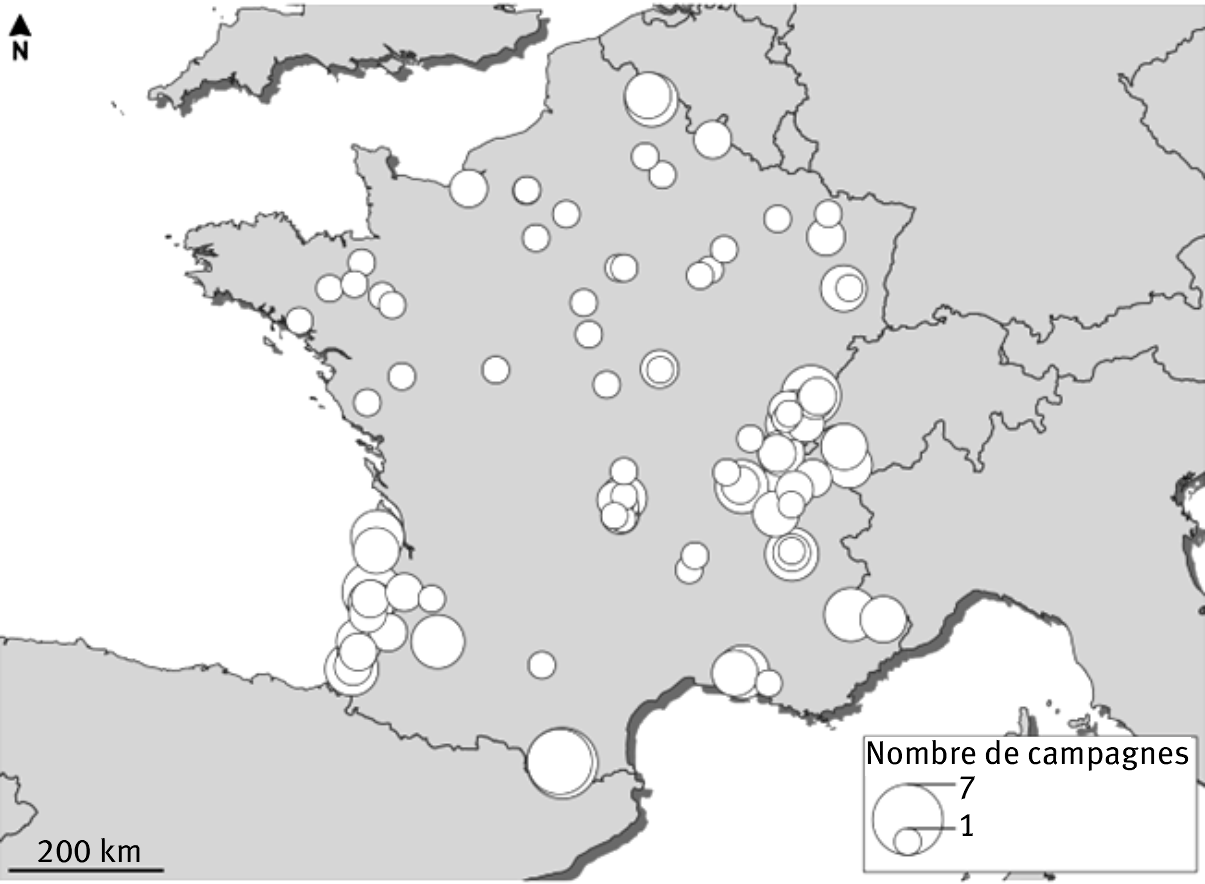
Figure 1. Plans d’eau échantillonnés et nombre de campagnes réalisées pour l’acquisition des données biologiques mobilisées pour le développement de l’IBDL.
Quelle méthode utiliser à partir des données récoltées ?
Les données abiotiques ont révélé des gradients de pression discontinus, avec une sous-représentation de données issues de lacs en mauvaise condition écologique. Cette situation relativement commune, soulignée par plusieurs auteurs en charge de la mise au point d’indices biologiques (Bennion et al., 2014), rend difficile la construction de profils écologiques fiables pour les taxons présents.
Dans l’optique de proposer un indice multimétrique et compte tenu de la spécificité des gradients environnementaux relevés, nous avons opté pour la méthode d’analyse nommée « Threshold Indicator Taxa ANalysis » ou TITAN (Baker et al., 2010). Associant l’identification de seuils de rupture dans les communautés à la détermination de taxons indicateurs, cette méthode permet de constituer une liste définie de taxons d’alerte selon la variable environnementale considérée, et de pallier ainsi la discontinuité du gradient environnemental au sein de nos données. TITAN présente également l’avantage de prendre en compte les taxons ayant une faible occurrence et/ou une faible abondance.
L’indice biologique diatomées en plans d’eau, un indice applicable à tout type de plan d’eau
En utilisant cette méthode, nous avons construit un indice multimétrique basé sur quatre gradients de pression (phosphore total, azote Kjeldahl, matières en suspension, demande biologique en oxygène) et 590 taxons indiciels dont 121 taxons d’alerte.
Si l’on compare pour un même plan d’eau les évaluations données par l’IBDL et l’IBML (indice biologique macrophytes en lacs), il est intéressant de noter que l’IBDL apparaît généralement moins déclassant (pour 18 échantillons sur 22). La littérature comparant les résultats de différents indices lacustres, bien que rare, converge en effet vers une surestimation de la qualité de l’eau par les diatomées. Ainsi les indices basés sur les diatomées peinent généralement à détecter de nouveaux plans d’eau impactés, qui n’auraient pas été déjà détectés par les indices macrophytiques (Kolada et al., 2016).
Pourtant, la réponse rapide du phytobenthos aux conditions du milieu justifie leur utilisation en routine (Schneider et al., 2019) en tant qu’alertes précoces de toute perturbation environnementale.
D’autre part, nos résultats montrent que les valeurs des métriques d’IBDL calculées à partir des listes de taxons échantillonnés sur des substrats minéraux ou sur des macrophytes pour une même UO convergent. Les résultats d’IBDL sont donc directement comparables quel que soit le substrat échantillonné. Cet aspect les rend incontournables lorsque les pressions hydrologiques dans les zones littorales lacustres limitent le développement des macrophytes, du fait notamment d’une amplitude du marnage annuel trop élevée (estimée à partir de 2 m) pour garantir leur développement. De plus, le calcul d’IBML peut être irréalisable pour les plans d’eau dont les communautés de macrophytes sont naturellement pauvres en espèces, voire absentes (Schneider et al., 2019). L’IBDL peut quant à lui être mis en œuvre dans tout type de plans d’eau.
Révisions d’un indice existant
Les performances et la robustesse d’un indicateur DCE dépendent fortement de nombreux paramètres, qu’il s’agisse par exemple de facteurs humains liés à l’acquisition des données (prélèvements, dénombrements, identifications taxonomiques) ou de facteurs statistiques, reliés aux approches choisies et au jeu de données ayant permis le développement de l’indicateur. L’IBDL et l’IPLAC sont ainsi calculés à partir d’une liste de taxons de référence, pour lesquels l’écologie a pu être décrite à partir des données disponibles lors de la phase de développement. Cependant, la taxonomie de ces taxons n’est pas figée dans le temps. Face à l’évolution de la taxonomie, il peut donc s’avérer pertinent de réaliser des mises à jour, afin de mieux prendre en compte cette évolution ainsi que les nouvelles données acquises. Cette étape de révision est ici illustrée pour l’indicateur le plus ancien, l’IPLAC.
Pour l’IPLAC, une baisse régulière et continue de la contributivité des communautés phytoplanctoniques, c’est-à-dire de la proportion des taxons pris en compte dans les calculs, est ainsi observée depuis la fin du développement de l’indicateur, à raison d’une baisse d’environ 1 % par an. Au long terme, cette baisse pourrait limiter les performances et la pertinence de cet indicateur. Une révision de cet indicateur a ainsi été menée en 2024. Elle a permis de remonter la contributivité, en passant d’environ 40 % à plus de 60 % des taxons identifiés pris en compte dans l’indice (figure 2), tout en conservant des performances similaires quant à la capacité de l’indice à représenter le niveau trophique des lacs. La part des espèces identifiées et prises en compte dans l’indice a aussi fortement augmenté passant de 60 % à près de 100 %.
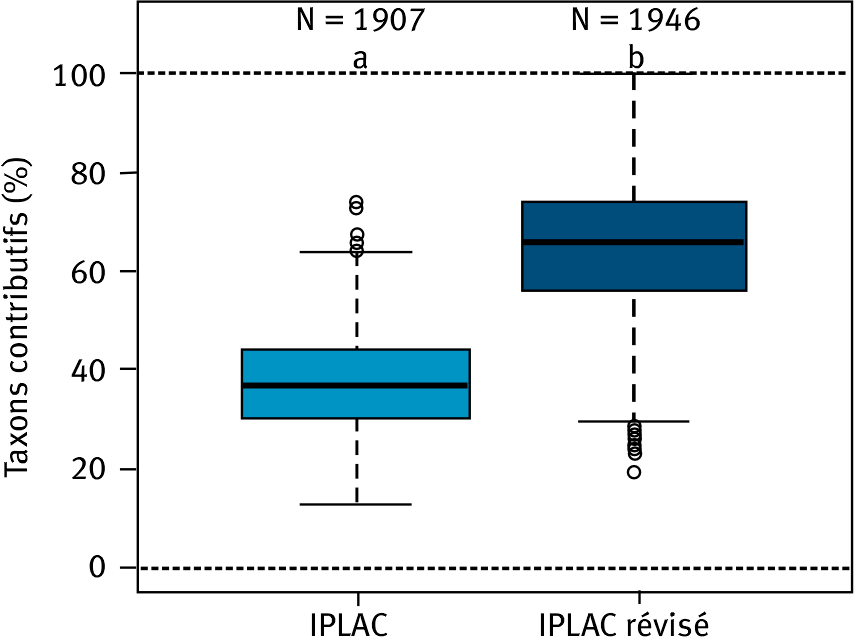
Figure 2. Comparaison de la richesse relative des taxons contributifs (%) de l’IPLAC, révisé ou non, par rapport à la richesse totale de l’ensemble des taxons quantifiés, respectivement pour 1907 et 1946 échantillons.
Cette révision a aussi permis de mieux décrire l’écologie de nombreux taxons, grâce à la multiplication des données disponibles permettant cette description. Pour certains taxons, dont les profils avaient été décrits sur la base de leur présence dans un petit nombre de lacs et d’années, cette révision a mené à des changements radicaux, mais plus réalistes, de la description de leurs préférences trophiques (figure 3). Par exemple, la cyanobactérie Aphanocapsa elachista, qui était auparavant considérée comme indicatrice de lacs hyper-eutrophes, présente des préférences plus mésotrophes après révision (cf. le point vert sur la figure 3). À l’opposé, l’algue verte Lemmermannia triangularis présentait avant la révision un score proche de 10, indiquant des préférences pour des conditions mésotrophes, et elle présente maintenant un score égal à zéro, indiquant ainsi qu’il s’agit du taxon retrouvé de fait dans les conditions les plus eutrophes du jeu de données (cf. le point rouge sur la figure 3).
Ces préférences sont exprimées sous la forme de scores compris entre 0 et 20, respectivement pour des taxons retrouvés dans des milieux hyper-eutrophes à oligotrophes. S = 160 taxons. Deux taxons sont mis en avant sur ce graphique (respectivement la cynaobactérie Aphanocapsa elachista, représentée avec un point vert, et l’algue verte Lemmermannia triangularis, représentée avec un point rouge) afin d’illustrer que la révision de l’IPLAC a pu mener à des changements conséquents des scores de certains taxons.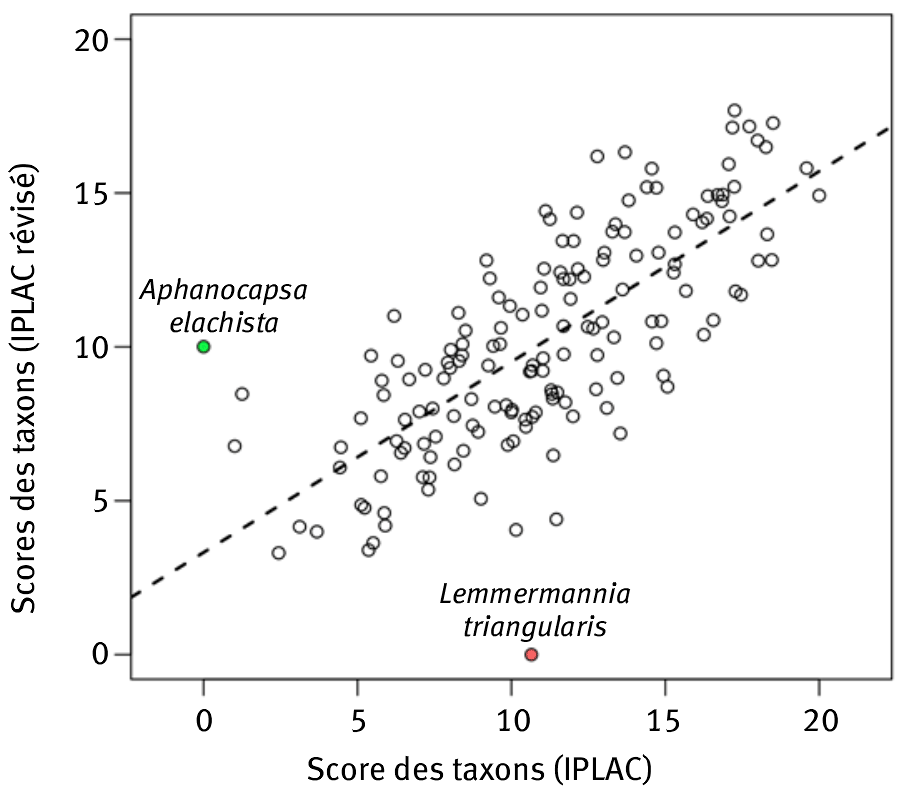
Figure 3. Comparaison des préférences trophiques des taxons contributifs pour la méthode IPLAC originale et pour la méthode révisée.
Intercalibration européenne des méthodes et résultats d’indices
L‘intercalibration européenne consiste à valider la compatibilité des méthodes d’évaluation utilisées par les différents États membres, d’harmoniser et d’ajuster le type de résultats et les valeurs qu’elles fournissent. Pour une pression équivalente, les méthodes des différents États membres doivent fournir un résultat comparable en niveau d’évaluation (niveau d’état écologique). Le processus d’intercalibration de l’IBDL est ici explicité.
Fixation des seuils d’état écologique
L’évaluation de l’état écologique d’une masse d’eau s’exprime en ratio de qualité écologique (EQR), défini comme l’état observé par rapport à l’état de référence. L’échelle des EQR est divisée en cinq classes (très bon, bon, moyen, médiocre et mauvais état écologique ; figure 4). L’état de référence est dérivé des évaluations obtenues sur les plans d’eau de référence, considérés comme exempts de pression humaine significative
Très bon, bon, moyen, médiocre et mauvais état écologique sont respectivement représentés en bleu, vert, jaune, orange et rouge.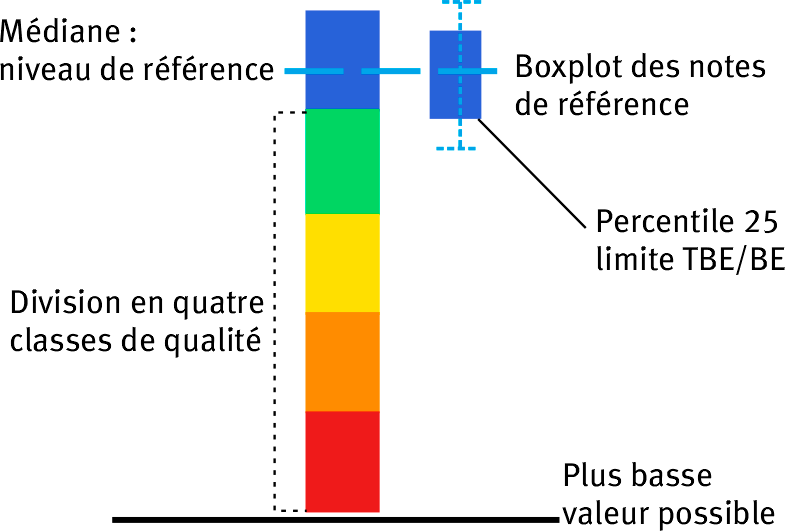
Figure 4. Principe de mise en place d’une grille d’évaluation de l’état écologique à partir des valeurs obtenues de métrique (TBE : très bon état ; BE : bon état).
La limite très bon état/bon état a été fixée au 25e percentile des notes de référence, selon la technique la plus communément adoptée par les pays membres participant à l’exercice d’intercalibration. Les limites inférieures ont été obtenues par divisions en parts égales du reste de la distribution.
Les différents seuils d’état écologique proposés, exprimés en EQR pour l’indice biologique diatomées en lacs (IBDL), sont reportés dans le tableau 1.
Très bon | Bon | Moyen | Médiocre | Mauvais |
[1-0,8[ | [0,8-0,6[ | [0,6-0,4[ | [0,4-0,2[ | [0,2-0[ |
Intercalibration des seuils d’état écologique et potentiel impact sur l’état des lieux
Les seuils très bon et bon doivent être intercalibrés entre États membres, afin de vérifier que notre système d’évaluation est compatible avec le standard européen (« common view »). La très bonne corrélation entre les scores d’IBDL et le gradient de phosphore total (R² de 0,64 à 0,81 selon le type de lac considéré, avec une p value < 0,001), critère clé pour considérer l’indice comme prêt à être intégré dans le processus (Kelly et al., 2014), a permis de mener l’exercice d’intercalibration. Cet exercice a abouti à la validation de nos seuils d’état écologique.
L’IBDL a ainsi intégré le panel d’indicateurs mobilisés pour la surveillance et l’évaluation des plans d’eau français. Le comité national de pilotage (CNP), qui réunit les directeurs des DREALs et DEALs
Transfert aux utilisateurs
Le transfert opérationnel de ces méthodes vers les acteurs de la surveillance de l’état écologique des plans d’eau nécessite de standardiser les techniques de prélèvement des microalgues et les techniques de calcul des indices. Normes, formations, bases de données et scripts de calcul ont donc été produits et mis à disposition des acteurs de la gestion des milieux aquatiques.
Normes d’échantillonnage
La norme en vigueur NF T90-354 « Qualité de l’eau –Échantillonnage, traitement et analyse de diatomées benthiques en cours d’eau et canaux » (AFNOR, 2016) est actuellement en cours de révision afin d’intégrer les préconisations de prélèvement de ces microalgues en plans d’eau, ce qui facilitera la mise en œuvre de l’IBDL.
Pour la mise en œuvre de l’IPLAC, la norme expérimentale, XP T90-719 « Qualité de l’eau – Échantillonnage du phytoplancton dans les eaux intérieures » (AFNOR, 2017) a été développée spécifiquement pour définir la méthode d’échantillonnage. Elle devrait être révisée dans les prochains mois, dans le cadre de la révision systématique, pour passer de norme expérimentale à norme valide. Elle est complétée par la norme européenne NF EN 15-204 (AFNOR, 2006) qui définit les règles de dénombrement du phytoplancton par microscopie inversée. Cette dernière est associée à un fascicule de documentation publié en 2024, FD T90-779 (AFNOR, 2024) qui en précise spécifiquement pour la France certaines modalités de mise en œuvre.
Formation des opérateurs
En partenariat avec l’Office français de la biodiversité, les acteurs en charge des prélèvements de diatomées lacustres ont été formés en amont de la mise en place de la campagne exceptionnelle d’acquisition des données, dédiée au développement de l’IBDL.
Une formation dédiée aux évaluateurs Cofrac
Mise à disposition des scripts et des bases de données
La base de données utilisée pour le développement de l’IBDL, ainsi que le script du programme permettant le calcul de cet indice sous le logiciel R sont libres d’accès et disponibles sur le site https://doi.org/10.57745/PDKBGB. Il est également possible de calculer les indices, IBDL et IPLAC, via le portail de l’évaluation des eaux (https://seee.eaufrance.fr/).
Logiciels
Pour la surveillance du phytoplancton, il a été développé dès 2009 un logiciel libre (Laplace-Treyture et al., 2017), nommé Phytobs qui peut être téléchargé depuis la page dédiée (https://hydrobio-dce.hub.inrae.fr/telecharger/logiciels/phytobs). Il assiste l’opérateur pour le dénombrement au microscope, permet la bancarisation et le transfert des données selon le Schéma national des données sur l’eau (SNDE) et permet le calcul de l’indice IPLAC et son exploitation. Il fait l’objet de mises à jour régulières (annuelles) pour tenir compte de l’évolution de la taxonomie et répondre aux attentes des utilisateurs. L’IPLAC, dans sa version révisée, y sera implémenté prochainement.
Conclusion
Au sein du Pôle R&D ECLA (Pôle Recherche et Développement Écosystèmes Lacustres)
Afin d’obtenir davantage de précisions sur les aspects méthodologiques liés au développement de l’IBDL, il est possible de se reporter à la publication : Tison-Rosebery, J., Boutry, S., Bertrin, V., Leboucher, T., & Morin, S. (2023). A new diatom-based multimetric index to assess lake ecological status. Environmental Monitoring and Assessment, 195(10), 1202. https://doi.org/10.1007/s10661-023-11855-w
La méthode mise en œuvre pour la révision de l’IPLAC est détaillée dans le rapport : Meyer, A. & Laplace-Treyture, C. (2024). Révision de l’indice Phytoplancton Lacustre (IPLAC) : refonte des notes spécifiques - Projet RevIPLAC, https://hal.inrae.fr/hal-05136578v1
Toutes les informations relatives à l’étude du phytoplancton en plan d’eau pour la mise en œuvre de la DCE peuvent être retrouvées sur le site Hydrobio-dce : https://hydrobio-dce.hub.inrae.fr/methodes-dce/methodes-plans-d-eau/phytoplancton
______________________________________
Photo d’entête : © Jean-Claude Druart (INRAE)
Notes
- 1. La liste des lacs de référence a été établie à partir de la circulaire DE/MAGE/BEMA 04/N 18 n° 2004-08 DCE du 23/12/04 relative à la constitution et la mise en œuvre du réseau de sites de référence pour les eaux douces de surface en application de la DCE.
- 2. Les directions régionales de l’environnement, de l’aménagement et du logement (DREAL) et directions de l’environnement, de l’aménagement et du logement (DEAL) dans les départements et régions d’outre-mer.
- 3. Comité français d’accréditation.
- 4. https://poleecla.fr/
Références
- AFNOR. (2006). Qualité de l’eau - Norme guide pour le dénombrement du phytoplancton par microscopie inversée (méthode Utermöhl). NF EN 15204.
- AFNOR. (2016). Qualité de l’eau – Échantillonnage, traitement et analyse de diatomées benthiques en cours d’eau et canaux. Association française de normalisation, Norme NF 90 T-354.
- AFNOR. (2017). Qualité de l’eau - Échantillonnage du phytoplancton dans les eaux intérieures, XP T 90-719.
- AFNOR. (2022). Qualité de l’eau - Échantillonnage des communautés de macrophytes en plans d’eau. Norme NF T90–328.
- AFNOR. (2024). Aide à l’application de la norme NF EN 15-204: 2006, FD T90-779.
- Baker, M. E., & King, R. S. (2010). A new method for detecting and interpreting biodiversity and ecological community thresholds. Methods in Ecology and Evolution 1(1), 25-37. https://doi.org/10.1111/j.2041-210X.2009.00007.x
- Bennion, H., Kelly, M. G., Juggins, S., Yallop, M. L., Burgess, A., Jamieson, J., & Krokowski, J. (2014). Assessment of ecological status in UK lakes using benthic diatoms. Freshwater Science, 33(2), 639-654. https://doi.org/10.1086/675447
- Feret, T., & Laplace-Treyture, C. (2013). IPLAC : L’indice Phytoplancton LACustre : Méthode de développement, description et application nationale. Rapport final. Irstea Groupement de Bordeaux, unité de recherche Réseaux, épuration et qualité des eaux. Rapport, 69 p.
- Guiry, M. D., & Guiry, G. M. (2023). AlgaeBase. World-wide electronic publication. National University of Ireland, Galway. https://www.algaebase.org
- Kelly, M., Urbanic, G., Acs, E., Bennion, H., Bertrin, V., Burgess, A., Denys, L., Gottschalk, S., Kahlert, M., Karjalainen, S.M., Kennedy, B., Kosi, G., Marchetto, A., Morin, S., Picinska-Fałtynowicz, J., Poikane, S., Rosebery, J., Schoenfelder, I., Schoenfelder, J., & Varbiro, G. (2014). Comparing aspirations: intercalibration of ecological status concepts across European lakes for littoral diatoms. Hydrobiologia, 734, 125-141. https://doi.org/10.1007/s10750-014-1874-9
- Kolada, A., Pasztaleniec, A., Bielczyńska, A., & Soszka, H. (2016). Phytoplankton, macrophytes and benthic diatoms in lake classification: Consistent, congruent, redundant? Lessons learnt from WFD-compliant monitoring in Poland. Limnologica, 59, 44-52. https://doi.org/10.1016/j.limno.2016.05.003
- Laplace-Treyture, C., & Feret, T. (2016). Performance of the Phytoplankton Index for Lakes (IPLAC): A multimetric phytoplankton index to assess the ecological status of water bodies in France. Ecological Indicators, 69, 686-698. https://doi.org/10.1016/j.ecolind.2016.05.025
- Laplace-Treyture, C., Hadoux, E., Plaire, M., Dubertrand A., & Esmieu, P. (2017). Phytobs v3.0 : Outil de comptage du phytoplancton en laboratoire et de calcul de l’IPLAC. Version 3.0. Application JAVA. https://hydrobio-dce.hub.inrae.fr/telecharger/logiciels/phytobs
- Morin, S., Valade, D., Tison-Rosebery, J., Bertrin, V., Cellamare, M., & Dutartre, A. (2010). Utilisation du phytobenthos pour la bioindication en plans d’eau : État de l’art des méthodes disponibles et test de métriques sur les plans d’eau aquitains. Rapport scientifique. Irstea. https://hal.inrae.fr/hal-02594105v1
- Poikane, S., Kelly, M., & Cantonati, M. (2016). Benthic algal assessment of ecological status in European lakes and rivers: Challenges and opportunities. Science of the Total Environment, 568, 603-613. https://doi.org/10.1016/j.scitotenv.2016.02.027
- Schneider, S. C., Hjermann, D. O., & Edvardsen, H. (2019). Do benthic algae provide important information over and above that provided by macrophytes and phytoplankton in lake status assessment? Results from a case study in Norway. Limnologica, 76, 28-40. https://doi.org/10.1016/j.limno.2019.02.001
- Stevenson, R. J., & Rollins, S. L. (2017). Ecological assessment with benthic algae. Dans G. A., Lamberti, & F. Richard Hauer, Methods in stream ecology (pp. 277-292). Academic Press. https://doi.org/10.1016/B978-0-12-813047-6.00015-2
- Tison-Rosebery, J., Boutry, S., Bertrin, V., Leboucher, T., & Morin, S. (2023). A new diatom-based multimetric index to assess lake ecological status. Environmental Monitoring and Assessment, 195(10), 1202. https://doi.org/10.1007/s10661-023-11855-w
- Union Européenne (2000). Water Framework Directive. J. Ref. OJL, 327, 1-73.
- Wu, N., Dong, X., Liu, Y., Wang, C., Baattrup-Pedersen, A., & Riis, T. (2017). Using river microalgae as indicators for freshwater biomonitoring: Review of published research and future directions. Ecological Indicators, 81, 124-131. https://doi.org/10.1016/j.ecolind.2017.05.066
Résumé
Les écosystèmes lacustres sont particulièrement impactés par les changements globaux. Les microalgues qu’ils hébergent, par leur cycle de vie court et leur position à la base du réseau trophique, offrent une réponse très rapide à ces modifications. Elles ont donc été particulièrement mobilisées par les scientifiques et les décideurs politiques à travers le monde afin de développer des indicateurs de surveillance de l’état écologique des écosystèmes lacustres et notamment de l’eutrophisation (Stevenson et Rollins, 2017). Au début des années 2000, la directive-cadre sur l’eau (DCE, Union européenne, 2000) a ainsi exigé de tous les États membres de l’UE qu’ils mettent en œuvre de tels indicateurs. Si en 2020 la France s’était déjà dotée d’un indice basé sur le phytoplancton, l’IPLAC, il lui restait encore à développer un indice basé sur le phytobenthos. Cet article fait le point sur ces deux indices, en mettant en lumière les différentes étapes nécessaires à la mise en œuvre de ces outils, de leur création à leur transfert concret auprès des gestionnaires, sans oublier leur nécessaire mise à jour régulière.
Pas de document complémentaire pour cet article
Statistiques de l'article
 Vues: 1861
Téléchargements
 PDF: 266
 XML: 60